Best car group tests 2025: the year’s top new models fight it out
There’s nowhere to hide on the Auto Express car group test and these were the tests that stood out in 2025.

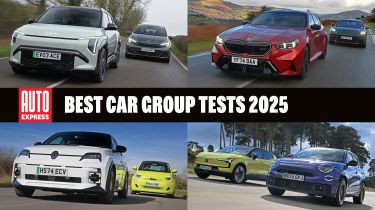
Testing cars in isolation is all well and good but you get a much clearer idea of its qualities by putting it head-to-head with a key rival. That’s where the Auto Express group tests come in, two or three cars tested on the same roads and under the same conditions in the UK. As a guide to which models really do set the standard on today’s market, it can’t be beaten.
In 2025 our expert road test team carried out a group test almost every week and it’s this intensive testing that forms the backbone of the car buying advice we give to you.
Of course, some stood out more than others, whether that was because of the surprise result, the closeness of the final decision or the imperious way in which one car dispatched its rival. Below you’ll find the Auto Express road test team’s pick of the best car group tests of 2025. Read all about what made them special and click the links to see the whole test in all its glory...
January
Kia EV3 backs up early promise with test win over Cupra Born
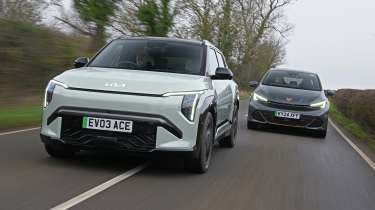
We first drove the Kia EV3 towards the end of 2024 and immediately knew the brand was on to a winner. So, in true Auto Express style, we couldn’t wait to pitch it against one of its key rivals to see if it had what it took to beat the class best – and less than four weeks into the year we did just that, with the EV3 stealing the silverware from the talented Cupra Born. Our road test team declared it the most compelling Kia EV to date, and, by extension, “one of the best on sale today”.
Panamera beats new M5
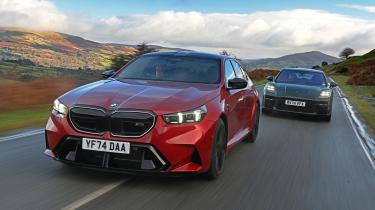
The controversial new-generation BMW M5 hybrid met its match in January, when it went up against the plug-in Porsche Panamera Turbo. This was a stern test for both cars, with each blending a turbocharged V8 engine with electric motors for around 700bhp of all-wheel-drive muscle.
A trip to Wales gave us the opportunity to test these cars on the roads they were designed to dominate, back to back over some of the UK’s most challenging tarmac. One thing was clear: neither car was short on poke. They’re not featherweights, and yet they both displayed an incredible ability to disguise their weight – thanks mostly to the masses of clever tech hidden under the skin.
But, as we discovered, these cars are anything but one-trick ponies. For a start, the lengthy drive from London gave us the opportunity to assess their long-distance refinement. The Porsche Panamera had the measure of the M5 here, feeling stable and comfortable while the BMW felt a “little too hardcore” and never seemed to relax.
We looked at everything, ranging from what the cars were like to drive, to the various tech highlights, how practical they were, their safety credentials and, of course, how much they’d cost to run.
Ultimately, it was the Porsche that came out on top. Our testers’ verdict declared the Panamera’s performance, handling, comfort and quality as “first rate”, making every journey “feel like an event”. We did acknowledge the fact that the lighter, cheaper Panamera GTS remained our pick of the range, however.
February
Impressive BMW X3 takes test honours
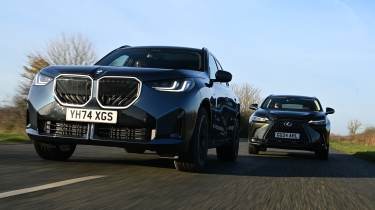
BMW’s all-new X3 impressed us late last year with its stunning interior and pin-sharp driving dynamics. But to get a true impression of a car’s pros and cons, you need to test it against one of its closest and most competent rivals – and in February, we did that.
Lining up against the luxurious and super-smooth Lexus NX, the petrol-powered BMW confirmed our initial thoughts and took the win, courtesy of its super technology, big boot and excellent powertrains. We declared it “a difficult car to fault” – an opinion that still rings true nine months later.
New Capri takes on Cupra in EV twin test
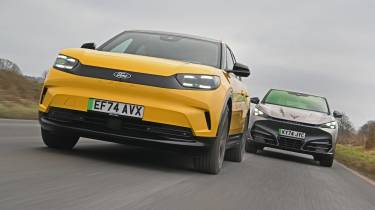
The modern-day Ford Capri will go down in history as one of the most controversial cars ever to grace the pages of Auto Express. Morphing from low-slung Essex-boy coupé to electric SUV in a single generation, the much maligned new car finally arrived in UK showrooms earlier this year.
But if you discount the polarising name, it’s actually a remarkably talented family car. Just not quite as talented as the also-new Cupra Tavascan, which took the victory in a closely matched twin test.
March
Alpine A110 bests Mustang
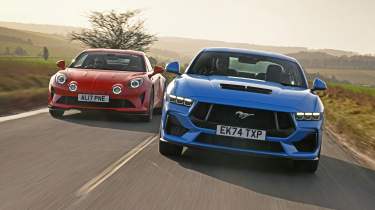
March was also a month of stark contrasts when we put two very different high-performance cars up against one another. Alpine’s low-weight philosophy rarely seems more stark than when sitting in the shadow of the iconic Ford Mustang muscle car, but which would appeal more?
This is something we discovered on some of the UK’s greatest roads, pitching sheer power against precision. And the victor? On the day it was Alpine’s clever, intuitive way of entertaining that outweighed the big-chested thrills of a Mustang and its superb V8 engine.
Funky and fun: Renault 5 takes on the Fiat 500e
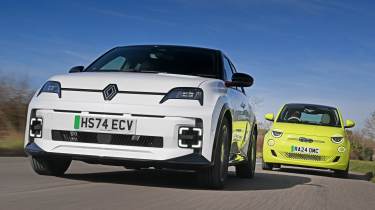
Last year was all about the launch of the fantastic Renault 5, so could the car’s sterling run continue into 2025? In short, yes. When we finally got the new R5 in the UK at the beginning of this year, it felt like there wasn’t a car it couldn’t take head on, so what about one with an even more ambitious stance on style? Cue a Franco-Italian contest between two undisputed fashion icons.
The Fiat 500e might have appeared to start this twin test with one hand behind its back thanks to its three-door footprint and smaller battery, but the latest model’s all-electric reinvention was a brilliant one. Rarely has a second-generation reboot of an icon done a better job than the original, but the 500e did just that. With even cuter proportions, elegant colours and finishes (although perhaps not the positively nuclear chartreuse yellow of our test car) and sleek new detailing, the 500e was a tough rival.
However, the design, value, range and interior combination of the Renault 5 was impossible to beat, taking each of these elements to a new level, and at a shockingly low price point. Our testers once again praised its design, brilliant Google-backed interior tech and its ride and handling.
It wasn’t perfect, though. There was still a little too much bounce to the ride, and the column stalks and boot opening can feel a little awkward, but in general we thought the Renault 5 wasn’t just a step forward for Renault, but a step towards making all-electric hatchbacks even more desirable than their petrol-powered counterparts. All was not lost for the Fiat, though.
Its teeny proportions made it the more convincing city car, and thanks to the excellent efficiency from the electric motor and battery, it would be an even more impressive addition to a family of cars based in urban centres. We also loved the interior design, which although simple, felt more sophisticated than the sometimes over-styled Renault.
What really split the two, however, was cost. Despite having better range, more space, more kit and more substance, the Renault still undercuts the smaller Fiat in price – and by a considerable margin. So, it was a worthwhile win (again) for the indomitable Renault 5.
April
Leapmotor T03 vs Dacia Spring: battle of bargain-basement EVs
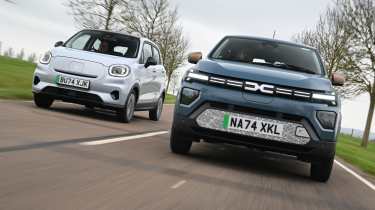
What are Britain’s cheapest EVs actually like to drive? This is something we tackled in April with the Dacia Spring and Leapmotor T03: two pint-sized, low-cost electric cars that shocked the UK press when they went on sale priced at less than £17,000.
Are they nice to drive? Not really. Yet they cost less than half of what an all-electric Vauxhall Corsa did just three years ago. But that’s the thing: throw a proper, second-hand EV into the mix and both the Spring and T03 start to make a lot less sense.
Test proves Model Y is stronger than ever
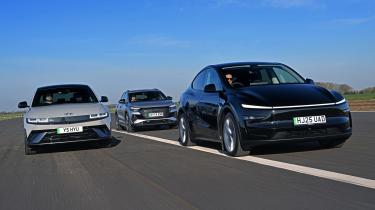
Is the Tesla Model Y still worthy of its world-beating sales performance? This was a question we posed by pitching it against two key EV rivals in April. And unlike the last version, which had a few fatal flaws, this new car definitely played a much stronger game.
Against the Audi Q4 e-tron and Hyundai Ioniq 5, the Model Y impressed with its efficiency, performance and interior space. However, as with all Teslas there are still plenty of aspects that won’t work for everyone, such as the heavy reliance on the touchscreen.
May
California is still the dream campervan
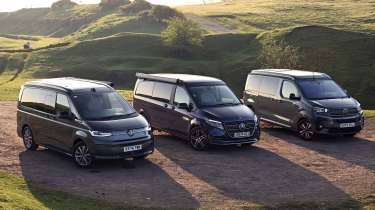
The Volkswagen California has been the king of campervans for decades, continually building on the manufacturer’s now 75 years of experience making the finest cribs on the campsite.
But it no longer has the class to itself. In May, we put the latest incarnation of the VW bus up against the new, excellently named Citroen Holidays and the Mercedes Marco Polo to see which is really the best home-away-from-home that money can buy.
Spoiler alert, the VW California won the triple test by some margin. Our expert testers said it was “clear that Volkswagen has put all of its know-how into the new California, because the superb all-rounder strikes the perfect balance between luxury, technology and affordability.”
They added the VW was also the best to drive, which makes sense, because the latest California isn’t based on a van like its rivals are. Instead, it finds its underpinnings in the Multivan people carrier, which uses the same MQB Evo platform as the Volkswagen Golf and Skoda Kodiaq.
Ultimately, “if you’re planning your next decade’s worth of trips away, there’s nothing that’ll do it better” than the California, according to our team. That said, the new Citroen Holidays was the undisputed value choice. Priced from £55,395, it's about £15,000 cheaper than the most basic California. And while it does sacrifice a few luxuries here and there, at the end of the day it’s still a campervan capable of sleeping four people, with its own kitchen facilities for a slap-up brekkie. A punchy diesel engine, soft ride and great visibility help make journeys very pleasant, too.
The Mercedes may have picked up the bronze medal, but there was no denying the Marco Polo’s performance, quality, finish and tech were all better than its rivals’. The model we drove even came with air suspension, making it superbly comfortable for long road trips – as well as getting the van perfectly level on the campsite.
However, its positive qualities were overshadowed by its lofty £88,455 starting price. And the example we tested weighed in at more than £98k – considerably more than its two talented rivals.
Volvo’s Scandi cool is too much for hot 600e
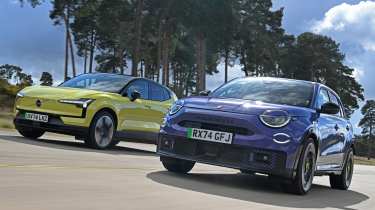
Italy and Sweden continued to have a very friendly relationship for most of 2025. However, the knives came out in Issue 1,883 when the fiery Abarth 600e went head-to-head with the cool Volvo EX30.
The Abarth was certainly more fun to drive and more characterful, but ultimately the Volvo triumphed because frankly it was better in every other way and would be a better car to actually live with. The ride was far more comfortable, the interior more luxurious and, this being a Volvo, the level of safety kit onboard was great.
June
Family SUVs face-off: Grandland vs Scenic
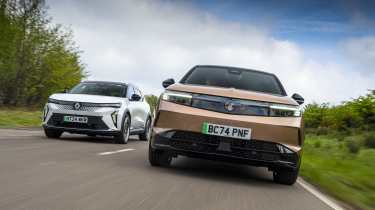
We staged a heavyweight title fight for electric family SUVs in which the new Vauxhall Grandland Electric went toe-to-toe with the highly regarded Renault Scenic. The Vauxhall came out swinging, with a huge amount of interior and boot space; overall we found the Mk2 Grandland to be a massive leap forward from its predecessor. However, that wasn’t enough to beat the Scenic, which won thanks to its ride quality, efficiency, technology and value for money.
July
BMW iX faces up to Lotus Eletre
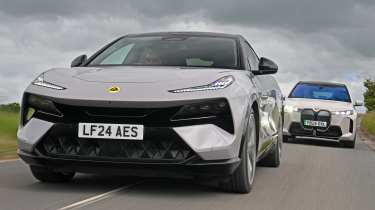
Cars doesn’t get much bigger in the EV world than the BMW iX and Lotus Eletre. These five-metre-long SUVs went head-to-head with 1,000bhp between them. The iX emerged victorious, thanks to recent mid-life improvements helping boost things including range, equipment and safety. The Eletre was a worthy competitor, with plenty of back-seat space and a luxurious interior. The handling was impressive too; just what you want from a Lotus, even one this size.
August
Peugeot 5008 takes on the Kia Sorento
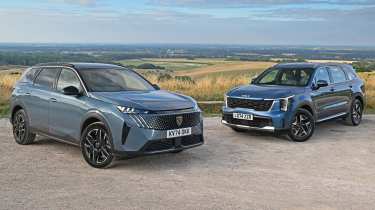
Two big, blue SUVs were the subject of our twin test: the Peugeot 5008 and Kia Sorento. Both were hybrids and both capable of seating seven. It was a close-run thing, but the Peugeot took the victory – music to the ears of photographer, Pete Gibson, who ended up running the exact same 5008 as his long-term test car for the next couple of months.
The Kia was the one to have for those looking to often use the third row of seats, otherwise it couldn’t overcome the French car’s interior quality, design and efficiency.
Alpine A290 turns up the heat on sporty MINI JCW
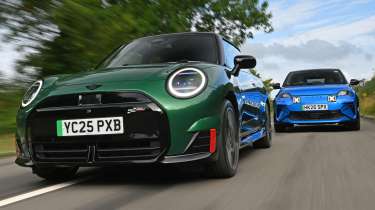
Would the success of the Renault 5 extend to the Alpine A290 GTS hot hatch? To find out, we put it up against the MINI JCW Electric. The MINI looked set to thrash the Alpine on paper: 254bhp from its front-mounted electric motor compared with the A290’s 217bhp, plus the MINI JCW Electric also had extra 40Nm of torque, could reach 62mph half-a-second quicker and boasted 25 miles more range (251 miles) than the Alpine.
But a great hot hatch, even an EV, doesn’t rely solely on numbers. The Alpine clawed back points with its fantastic Google-based infotainment, which makes the round touchscreen in the MINI look and feel awkward and convoluted. Then there’s the practicality to consider: five doors will always beat three, and rear-seat room was miles better than the MINI. Boot space (all 326 litres of it) was still much more than the MINI as well.
The real reason you’d buy the A290 GTS over the regular R5 is the way it drives – another area where the Alpine took chunks out of the MINI. It’s softer than the bone-shaking JCW, but the ride comfort didn’t sacrifice cornering engagement. The A290 can carry lots of speed into a bend, with great steering feel helping build confidence. It’s not quite the all-electric interpretation of old RenaultSport Clios, but we had lots of fun behind the wheel, despite its lack of a limited-slip diff.
While the MINI wasn’t without fault, we found it nicely responsive on the throttle. There’s a lot of potential within its chassis, too, but the firm ride meant it was only really enjoyable on super- smooth roads. We could feel even the slightest imperfections in the tarmac amplified by the stiff suspension and massive wheels.
The Alpine took the win – securing a four-star Auto Express road-test verdict. Beware, though: the standard Renault 5 offers 90 per cent of the A290’s thrills for a fraction of the price.
September
Audi RS 3 takes on Honda Civic Type R
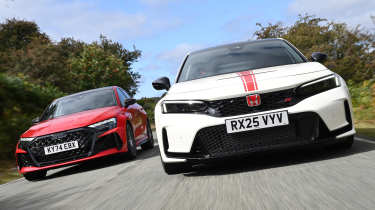
The new Audi RS 3 was always going to have a tough fight on its hands against our reigning Hot Hatch of the Year, the Honda Civic Type R. But as testimony to the mid-life updates Audi made to its capable flagship, it was a close-fought contest. The Audi’s turbocharged five-cylinder remains a real highlight and new torque-vectoring technology means it is more communicative in the bends. Even with a lot less power, the Civic Type R’s chassis still shines and the manual gearbox is a true delight. Its title as 2025’s best hot hatch remains intact.
October
Family car group test sees Qashqai take triple crown
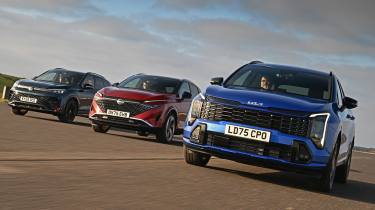
What is the best real-world family car? This was the question we posed back in October when our test team pitched the updated version of the UK’s second-biggest selling car against two of its keenest rivals. The Kia Sportage locked horns with the Nissan Qashqai and Volkswagen Tiguan in one of 2025’s most-read road tests.
The Nissan Qashqai required little introduction. It’s the car that many consider to have invented the mid-size SUV segment back in the late noughties. Now in its third generation it still sits at or near the top of the sales charts each month. To keep it competitive, Nissan has granted it another round of upgrades – specifically focused on its hybrid powertrain.
We found its e-Power system to be seriously impressive, with the range-extender drivetrain making it feel like an EV that never needs to be charged. It was refined, powerful and efficient, and showed the progress that Nissan has made with its hybrid technology.
It impressed inside the cabin, too, with a Google-integrated infotainment system showing up both rivals in terms of user-friendliness and its embedded features.
The Volkswagen Tiguan appealed on a different level, with a spacious interior and impressive residuals. However its mild-hybrid powertrain was the least impressive of our group, and felt closest to a standard combustion-powered car when it came to performance and efficiency. The Kia represented a solid middle ground, offering good performance and space, a new look and an updated interior, but lacking slightly when it came to efficiency and tech.
It was the Qashqai that prevailed, despite its relatively high price and limited boot space. That’s not to say that the VW and Kia weren’t worthy competitors, it’s just that, right now, Nissan’s Qashqai is the car to beat in this segment.
November
Merc CLA lands knockout blow on Model 3 champ
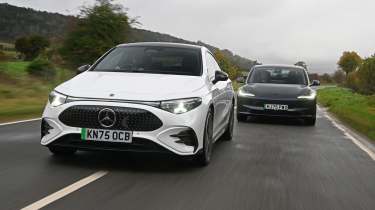
The Tesla Model 3 has set the electric car benchmark ever since it arrived in the UK back in 2019; it was, quite simply, the car all-comers had to beat. And it’s testament to the Tesla that, over the past six years, very little has come close to taking its crown.
But in November, the new Mercedes CLA threw the cat among the pigeons and beat the American EV at its own game. We praised the CLA for its long range and strong efficiency, plus its tech-filled cabin that felt much better screwed together than many modern Mercs.
Plenty of cars have battled it out, but which one would you like to drive? Tell us in the comments…
Find a car with the experts