New Nissan GT-R T-Spec 2026 review: a ferocious and fitting farewell
We take a blast in the final R35 version of Nissan’s performance hero

Verdict
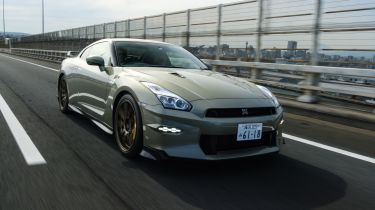
The MY25 T-Spec is the best R35 Nissan GT-R we’ve ever driven on account of its fine balance. But any R35 GT-R is a mind-blowing experience.
We’re in Japan to drive the final Nissan GT-R as we know it, a genre-bashing super-sports car that throughout its lifetime constantly proved the European ultra-high- performance establishment wrong.
Technically, the GT-R stopped being sold in the UK in 2023, but it continued in other markets for another couple of years, culminating in the final MY25 T-Spec edition you see here. Finished in an iconic shade of Millennium Jade, offset with gold magnesium wheels, carbon-ceramic brakes and some subtle styling changes that came along with the 2025 update, it’s very desirable.
But first some history. The GT-R started life as a high-spec version of the Skyline family car, running through various generations in the late sixties and early seventies. But it wasn’t until 1989 that a version based on the R32 set the template for the giant-killer’s technical make-up, generating its ‘Godzilla’ nickname in the process.
This was a time when Japanese brands had agreed on a power limit of 276bhp, but the 2.6-litre straight-six petrol engine with two turbos produced significantly more. This was sent to a rear-biased all-wheel drive system, and did so in a two-door body with space for four people, plus luggage in the boot. Just as the Honda NSX proved that supercars could be reliable and driveable every day, the GT-R was a warning sign to cars like the Porsche 911 Turbo that supercar-beating all-weather performance wasn’t just the preserve of the German premium brands.
Used - available now

2022 Volvo
XC40
50,185 milesAutomaticPetrol1.5L
Cash £19,100
2024 Volkswagen
Golf
67,155 milesAutomaticDiesel2.0L
Cash £15,200
2022 Peugeot
208
17,331 milesManualDiesel1.5L
Cash £12,700
2023 Tesla
Model Y Premium
48,817 milesAutomaticElectric
Cash £22,000In 2007, the R35 version was born – around the time Porsche’s 997-generation 911 Turbo arrived. The stakes were now much higher, so Nissan knew that a family car was no longer a suitable base for the GT-R. So the firm did something bold. By disconnecting from the Skyline entirely, engineers took the fundamental powertrain package and went a bit wild. The chassis, body, interior, engine, gearbox and even its assembly plant were all made to measure.
The engine was still front-mounted, now a 473bhp 3.5-litre V6, and connected to one of the most complex chassis layouts the car world has seen. To keep the weight distribution where it wanted it, Nissan fitted a transaxle dual-clutch gearbox, but being all-wheel drive it needed a way to get power back to the front wheels. It did this through a second driveshaft snaking its way back up under the car. There are also clever active differentials at both ends that can send power and torque exactly where they need to go.
Lots of R35 variants have been available over its 18-year lifespan, including a collection of fairly extensive visual and tech upgrades that saw various front-end designs, dashboards and colour options. There have also been ‘Track Pack’ models, plus pricey Nismo variants with the extensive use of carbon-fibre body panels, lower weight and a power increase to 592bhp.
The MY25 T-Spec that we’re driving never made it to the UK, but it combined some of the Nismo’s technical updates under the bonnet, a set of forged RAYS wheels and carbon-ceramic brakes with a more ‘relaxed’ suspension tuning. Power is rated at 562bhp, and it weighs 1,760kg.
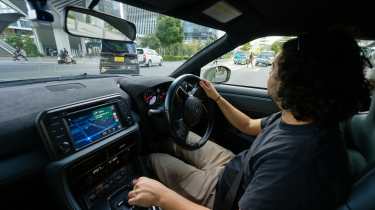
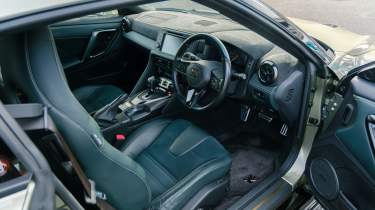
Sitting in front of the same dial set, with a big, centrally mounted rev-counter mounted directly to the steering column, this could only be a GT-R. It might be a 2025 car, but there’s lots here to remind us of its origins from nearly 20 years ago. There’s a physical handbrake, for instance, a chunky, mechanically connected gear selector and the three switches by the centre console that tweak the powertrain, suspension and traction control.
Just as with its predecessors, the R35 was initially saddled with a reputation for being a little sanitised or uninvolving. But this couldn’t be further from the truth. Select Drive then pull away and it’s more like a Lamborghini Aventador than a Volkswagen Golf GTI. This car doesn’t like to move slowly.
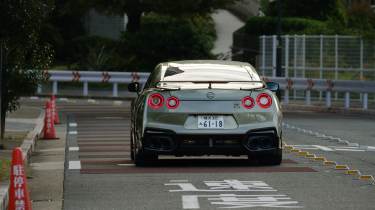
Our journey from Nissan’s Yokohama HQ took us out to the forested hills on the other side of Nagoya and eventually on to Osaka. We stopped at Daikoku, a spiritual home of the GT-R – and the modification scene it spawned. Our early arrival meant that we avoided the not-exactly-legal nature of the informal car meets that generally take place every night.
After a few photos, we found roads en route to Tokyo that cemented why the R35 is an icon. There’s lag from the turbos, but once they’re wound up, the car has colossal performance. It’s power you can feel coursing its way up and down the drivetrain, and when you’re really on it, from left to right. The steering, which can be a bit cumbersome at low speeds, now writhes with feel, theoretically telling you how much grip is available. We say theoretically because on this warm day, the track-spec Toyo rubber has far too much grip to give up the ghost.
The drive back after a sprinkling of rain reveals this car’s true balance. Take a few more liberties with the throttle and the all-wheel drive system shows off its rear bias – the GT-R isn't afraid to keep you on your toes, with great chunks of oversteer possible when the turbos come on song. Yet it’s all so manageable, underpinned by the exquisite balance from the over-complex drivetrain.
One big difference we found between this T-Spec and earlier models is the subtlety of the suspension tune. This is not a brittle or stiff car like earlier iterations were, instead there’s a wonderful fluidity and roundness to the ride that doesn’t dissipate even if you switch the dampers to a firmer setting. This makes the GT-R so much more usable, and while it is tricky to find truly horrible road surfaces in Japan, there are a few smaller roads that gave the suspension a bit of a workout.
This could well be our preferred variant in the UK, which makes the fact it never made it here more disappointing. So after a few days with the car, it has tunnelled its way ever deeper into our collective hearts, which poses the question: what’s next?
The main reason for our escapade to Tokyo was that it also coincided with the Mobility Show, where Nissan's fellow domestic brands threw caution to the wind to show off the future of Japanese engineering. But Nissan’s stand had no big-budget concept cars to preview what’s coming up next.
The GT-R has been a contentious car for the firm in its modern era, and as Nissan fights the headwinds that all legacy brands face in the electric age – increasing Chinese competition and ever-tougher geo-political conditions – there’s been no official decisions made for the next one. “It will come” has been a common response when we’ve spoken to executives, but beyond this, it feels like even they don’t yet know in which direction to take it.
And while it might feel a little foolish to invest in an expensive new low-volume model, there’s only really one thing that’s left to separate mainstream brands from their immediate newer competition, and that’s legacy. A new GT-R wouldn’t just be good fodder for the few that venerate cars like this, but it would reinforce Nissan’s incredible engineering capability. This value only comes through time and respect, not investment. Driving the R35 one last time didn’t remind us just why the GT-R matters, but also why Nissan matters. Don’t let us down.
Now you can buy a car through our network of top dealers around the UK. Search for the latest deals…
| Model: | Nissan GT-R T-Spec MY25 |
| Engine: | 3.5-litre V6 petrol, twin-turbo |
| Power/torque | 562bhp/633Nm |
| Transmission: | Six-speed dual-clutch auto, four-wheel drive |
| 0-62mph: | 3.6 seconds |
| Price: | ¥22,891,000 (£110,815 est) |
More reviews
Car group tests
In-depth reviews
Road tests
Used car tests