Vauxhall Frontera Electric review
Small SUV is spacious, practical and has value on its side, and it wears a famous badge from Vauxhall’s past


Our opinion on the Vauxhall Frontera Electric
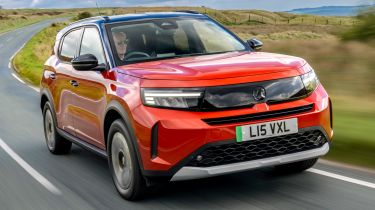
If you’re looking for a spacious five-seat family electric SUV on a budget, then the Vauxhall Frontera Electric has a lot going for it. It ticks all the above boxes because it has plenty of room for the money for passengers and luggage, while there’s a decent amount of kit on board, too.
It’s bigger than the more expensive Vauxhall Mokka, although when lined up side by side, you can tell where money has been saved in the Frontera with its harder plastics. There’s a choice of battery sizes in the Frontera Electric, although thanks to the motor’s low power, the powertrain feels like it can only just manage the SUV’s size and weight.
While the Frontera isn’t the most fun car to drive, it’s easy to manoeuvre and should keep passengers happy with the space and comfort it has to offer.
About the Vauxhall Frontera Electric
The Vauxhall Frontera is a direct replacement for the Vauxhall Crossland, a car so forgettable that you’d be forgiven for failing to remember what it looks like. You’re more likely to recognise the Frontera name from Vauxhall’s nineties SUV. That car was a rebadged Isuzu, and this new Frontera is also a joint production, because it’s largely the same as the second-generation Citroen C3 Aircross, so it comes in hybrid or all-electric guises.
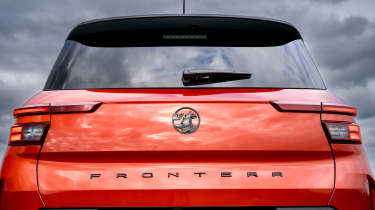
Both the Frontera and C3 Aircross use the same bodyshell and running gear, while a few key design cues separate them. The Frontera gets Vauxhall’s Vizor front end, for instance, while the tail-lights are of a different design, too. Inside, the Vauxhall’s layout has more in common with the Mokka, featuring two digital screens instead of the Citroen’s single screen and a slender digital driver’s display set above the steering wheel.
The Frontera only comes with front-wheel drive and a single electric powertrain, featuring a 111bhp electric motor and the option of either 44kWh or 54kWh batteries.
Vauxhall Frontera Electric prices and latest deals
Size-wise the Frontera sits between the Mokka and Grandland in the Vauxhall line-up, but it actually undercuts the former on price. The Frontera Electric starts from around £24,000 before any Electric Car Grant is factored in, which is around £8,000 less than the Mokka Electric. That’s for the Design model, while the mid-range GS is £2,500 extra, and the top-spec Ultimate is another £3,200 more. Upgrading any of these models to the Extended Range battery adds £3,500 to the price. Interestingly, the Frontera Electric has lower list prices than the hybrid model.
Vauxhall regularly offers discounts on list prices, so it’s worth keeping tabs on the latest deals via the Auto Express Buy A Car service to see what tempting offers are currently available.
Performance & driving experience
Pros |
|
Cons |
|
There is plenty of comfort on offer in the Vauxhall Frontera Electric, which is what you really want from a compact family SUV such as this. We’d like some more performance, though, because the car feels underpowered.
Unlike the old Frontera, this version is front-wheel drive only, so there’s no real off-road ability to speak of.
| Model | Power | 0-62mph | Top speed |
| Frontera Electric | 111bhp | 12.8 seconds | 88mph |
| Frontera Electric Extended Range | 111bhp | 13.0 seconds | 88mph |
Electric motors, 0-60mph acceleration and top speed
We were surprised that the electric model felt so sluggish. However, it only has 125Nm of torque, which isn't quite enough to help the Frontera to sprint off the line in a spirited fashion. The 44kWh manages 0-62mph in 12.8 seconds, while the heavier 52kWh model takes longer at 13.0 seconds, and both of those times are before you add passengers and their luggage. For comparison, the 110bhp Hybrid produces 205Nm of torque and accelerates from 0-62mph in 11 seconds, while the more powerful 145bhp version delivers 230Nm of torque and completes the same sprint in 9.0 seconds.
In the real world, the electric powertrain is smooth and fuss-free, but you have to wait for larger gaps when pulling on to a roundabout, for example. The extra weight of the Extended Range model blunts the car’s acceleration even further.
Town driving, visibility and parking
A high driving position offers a good view of your surroundings, while light controls mean the Frontera is easy to drive. Front and rear parking sensors help with positioning the car, while a reversing camera is also fitted as standard.
Low-speed comfort is decent, with only the biggest potholes unsettling the car, while the light steering and relatively tight turning circle help with manoeuvrability. We just wish the engines were a bit more responsive.
There are two levels of energy recovery on offer, with the stronger setting set as the default. It’s not the most powerful regeneration we’ve experienced, but you soon get in tune with its ability and adjust your driving style to make the most of it.
Country road driving and handling
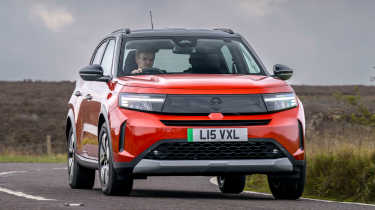
On faster roads the Frontera is competent, but in no way exciting to drive. The only real challenge is trying to maintain momentum to make up for the car’s relative lack of power.
Body roll is well contained in most instances and there’s good grip, while the electric model feels more stable and sure-footed than the hybrid car, helped in that regard by the weight of the battery set low in the chassis.
Motorway driving and long-distance comfort
Once you’re up to the national limit, the Frontera is pleasant enough. Only the biggest bumps unsettle the ride, while wind and road noise are well suppressed.
Throttle response is a little jerky when lifting off the accelerator, but if you switch from the standard energy recovery setting to the Comfort setting (via a ‘C’ button next to the drive selector), this sees the Frontera coast when lifting off, so progress is smoother.
Unsurprisingly, the Frontera drives much like its C3 Aircross sibling. In common with the Citroen, it’s not as refined as other Stellantis products that use the CMP architecture, but its Smart Car platform does offer some nimbleness, despite the Frontera’s size. - Alastair Crooks, senior news reporter
Range, charging & running costs
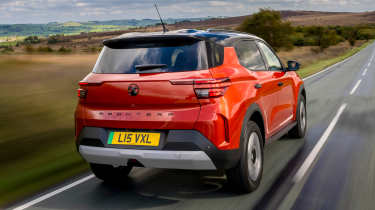
Competitive pricing puts the Frontera in a positive light before you’ve even got behind the wheel.
Electric range, battery life and charge time
Officially the Frontera Electric has a range of 186 miles, which isn’t much to write home about in itself, but actual real-world efficiency was even poorer when we tested this model.
Cold weather contributed to poorer returns (there’s no heat pump available to help take a load off the battery when it’s cold) but a figure of 2.8 miles per kWh results in a range of only 123 miles.
One issue with the Frontera – and something that we’ve found is common with a variety of other Stellantis EVs – is that higher speeds have an impact on efficiency. This is common with all EVs, but it’s a particular issue with Stellantis products, where anything faster than 45-50mph sees the battery drain at a faster rate. At one point when travelling at 70mph in the Frontera, we were losing one per cent of battery capacity for every mile covered, but this soon recovered again at urban speeds.
The Extended Range version has an official figure of 249 miles, but again, there’s no option of a heat pump, and it will likely suffer the same drop in range at higher speeds. Plus it’s a sizable £3,500 more expensive than the standard Frontera Electric.
Charging speeds are decent courtesy of the small battery sizes. There’s a maximum DC rate of 100kW, so the 44kWh battery can charge from 20-80 per cent capacity in 26 minutes, while the 54kWh pack isn’t far behind at 28 minutes. From a 7.4kWh wallbox you can recharge the 44kWh battery from flat to full in seven hours, while the 54kWh pack takes eight-and-a-half hours.
| Model | Battery size | Range | Insurance group |
| Frontera Electric | 44kWh | 186 miles | 15 |
| Frontera Electric Extended Range | 54kWh | 249 miles | 14 |
Insurance groups
The Frontera line-up sits between groups 14 and 20 in either hybrid or electric form, so premiums should be pretty reasonable. In comparison, the BYD Atto 2 sits in groups 30 and 32.
Tax
Company car drivers paying Benefit-in-Kind (BiK) tax should choose the Vauxhall Frontera Electric over the hybrid version. The EV incurs a three per cent BiK while the hybrid sits in the 29 per cent bracket.
Depreciation
Unfortunately, our expert data suggests that the Frontera isn’t expected to hold its value particularly well, with the all-electric model retaining 34 to 37 per cent after three years and 36,000 miles. The hybrid fares slightly better with 42 to 44 per cent after the same period. In comparison, the BYD Atto 2 holds on to 42 per cent of its value.
To get an accurate valuation for a specific model, check out our free car valuation tool...
Interior, design & technology
Pros |
|
Cons |
|
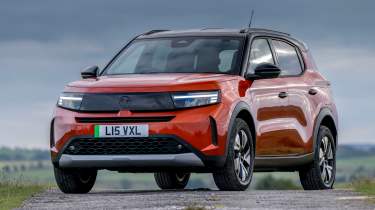
Vauxhall’s distinctive Vizor grille helps the Frontera to stand apart from the C3 Aircross, as does a dashboard layout that foregoes that car’s high-set digital display for a more conventional screen behind the steering wheel.
The Frontera’s blocky side profile and upright stance give it an almost MPV-like shape, while adding the £400 white wheels and roof has a dramatic effect on the model’s style; from some angles it almost mimics the Land Rover Defender.
Interior and dashboard design
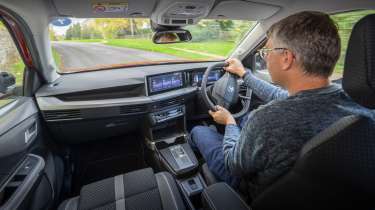
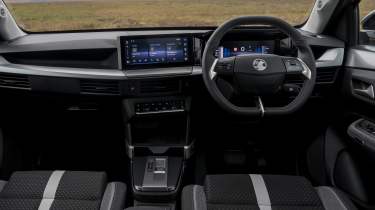
The Frontera’s cabin layout is straightforward, with a straight-edged dashboard and centre console, twin digital displays and some smoked silver trim to give some relief from the black plastic used across the majority of the interior. There are neat little ‘shark’ motifs here and there – a common Vauxhall design touch – while the twin cup holders feature an elasticated fabric strap that stretches around the binnacle that the drive selector sits in, so oversized drinks bottles are easier to fit in.
Materials and build quality
Cabin build quality is good, although the hard plastics used inside do give away the Frontera’s budget leanings. The fabric seat upholstery is decent and should be easy to clean, while higher-spec GS models and above add more fabric trim to the dashboard and doors to boost their premium appeal.
Infotainment, sat-nav and stereo
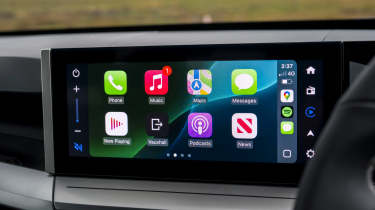
Twin 10-inch displays sit on the dashboard, with the central touchscreen angled towards the driver for easier access and a small cowl over the driver’s display to help reduce reflections. There are separate climate controls, too, with a trio of chunky rotary controls on Design-spec cars or chunky buttons and toggle switches on models featuring climate control.
The Vauxhall’s native infotainment system is used in a number of other Stellantis models, and features touch-sensitive volume and shortcut controls on either side. The infotainment took a little while to boot up for us once, but it’s responsive to inputs. The menu interface is easy to navigate, although that’s more to do with the fact that it’s a basic set-up. The driver’s display can be changed to show different information, but only to a small extent, with efficiency and trip information on offer.
I feel the Frontera has a much more natural driving position compared with its C3 Aircross sibling. The larger steering wheel in the Frontera means you can see the digital display directly behind, whereas I have to drop the steering wheel into my lap in the C3 Aircross in order to see the dials. I’d like to have a bit more information from the trip computer in the Frontera, though. – Dean Gibson, senior test editor
Boot space & practicality
Pros |
|
Cons |
|
While the petrol hybrid version of the Frontera has the option of seven seats, the electric car is simply a roomy five-seater.
Dimensions and size
The Frontera costs less than a Mokka, but you get more car for your money, because it’s longer, taller, and has a far bigger boot. In fact, it’s probably one of the best-value cars around in terms of space per pound.
| Dimensions comparison | |||
| Model | Vauxhall Frontera | Vauxhall Mokka | BYD Atto 2 |
| Length | 4,385mm | 4,150mm | 4,310mm |
| Width | 1,795mm | 1,987mm | 1,830mm |
| Height | 1,655mm | 1,534mm | 1,675mm |
| Wheelbase | 2,670mm | 2,561mm | 2,620mm |
| Boot space | 460-1,600 litres | 310-1,060 litres | 400-1,340 litres |
Seats & passenger space
The Frontera has a relatively tall and narrow body, so access to the cabin is straightforward, and the driving position provides a good view out. There’s plenty of wheel and seat adjustment on offer to get comfortable, too.
Storage includes those twin cup holders with elasticated sides, while there’s a shelf ahead that adds wireless phone charging below a pair of USB-C sockets. Further back, there’s a storage tray behind the electric handbrake and an armrest with a narrow bin beneath it, while the door bins are wide and deep with high sides. As with other Stellantis models, the glovebox is compromised on right-hand-drive cars due to the location of the fuse box.
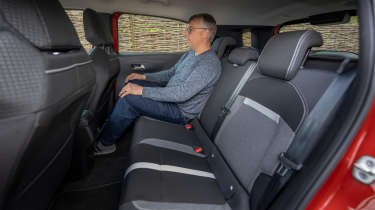
There’s plenty of kneeroom in the back of the Frontera, and while the cabin is a little narrow for sitting three abreast, the extra legroom and headroom on offer will help to mitigate against this. The floor is relatively flat for the middle seat, although there are no air vents in the back, just two USB-C sockets and a 12-volt supply beneath.
As with the front door bins, those in the rear are deep and wide, while there are two sets of Isofix child seat attachments in the back.
Boot space

There’s a generous 460 litres of luggage capacity on offer in the Frontera as standard, and there’s a false floor that allows you to carry charging cables separately from the rest of the boot. The rear seats have an offset split to boost versatility, while the backs slope up slightly to help with unloading larger items. When the rear seats are folded, a maximum capacity of 1,600 litres is available. One sign of cost-cutting in the Frontera is the parcel shelf. It doesn’t have clips to locate it, just notches cut out of the panel that sit on the hooks on either side of the load area.
Unlike the hybrid Frontera, there’s no seven-seat option in the electric model because the drive battery takes up space where the third row would be. We don’t feel that’s a hardship, though, because the rearmost chairs in the seven-seater are only really for occasional use by kids anyway.
There are plenty of little places where you can see the cost-cutting in the Frontera – there are no front grab handles for example, the glovebox isn’t damped and is very cheap, there’s no light on the passenger sun visor, and it hasn’t got the brake hold function that a lot of autos have. – Paul Barker, editor
Reliability & safety
Pros |
|
Cons |
|
With a powertrain that’s been tried and tested in a range of other Vauxhall and Stellantis products, plus a platform that’s shared with the Citroen C3 Aircross, C3 and Fiat Grande Panda, there is plenty on board the Frontera to help it deliver a reliable and dependable ownership experience.
Neither the Frontera nor the platform-sharing C3 Aircross has been tested by Euro NCAP yet, but whichever one is tested, they will both get the same score because they have so many common parts.
There is a decent list of safety kit as standard, including rear parking sensors, lane assist, active braking, collision warning, speed limit recognition and driver attention alert. Even better is that Vauxhall equips the Frontera with switches on the dashboard so that you can choose to deactivate the speed limit and lane departure warnings if you wish.
Vauxhall offers a basic three-year/60,000-mile warranty, but the drive battery is covered for eight years, and if you opt for the company’s Electric All In offer, you get eight years of roadside recovery thrown in, too.
Service intervals for the Frontera Electric are every 24 months or 16,000 miles. Interestingly, these are the same intervals for the hybrid model, although service plans start from around £13 a month, compared with £20 a month for the combustion-engined option.
Buying and owning
- Best buy: Vauxhall Frontera Electric GS Extended Range
It goes against the Frontera’s value pricing brief, but the higher-spec GS adds some luxury to the mix, while the bigger 54kWh battery will help to ease any range anxiety.
Vauxhall Frontera Electric alternatives
The obvious rival is the Citroen C3 Aircross, which is a similar price and has the same powertrain options. But as already mentioned, the different driving position required to see the dials might be a deal breaker for some. Other electric alternatives include the BYD Atto 2, which isn’t as roomy as the Frontera but has better efficiency and a longer range. The Jaecoo 5, Suzuki e Vitara and Toyota Urban Cruiser are a similar price, but nowhere near as spacious.
Frequently Asked Questions
It offers a lot of space for the money, but it does feel as if it’s been built down to a cost in places. If you can live with that and the rather short range, then it could be all the family SUV you need.
Deals on the Vauxhall Frontera and alternatives
More reviews
In-depth reviews